

Breakthroughs in repeater technology have led to a new school of thought as the mobile industry confronts the indoor coverage challenge. As Femtocell business models, standards and interference concerns are discussed and debated, a parallel approach for optimizing the indoor voice and data experience of residential subscribers is emerging fast — and it does not require a cooperative alliance (or a competitive reliance) on fixed line DSL or cable broadband providers.
Smart Repeaters are characterized by their ability to seek out the best available signal and automatically adjust to any changes in the RF (Radio Frequency) environment in order to maximize the signal gain to the user. With an intelligent onboard processor, they are designed to protect the integrity of the cellular network while increasing the effective capacity of each base station. They can literally triple (at a minimum) the data rates experienced by wireless subscribers in their homes.
Deployment complexities do not exist. Any subscriber can install a smart repeater in a matter of minutes. No cables. No ladders. No drilling, No interference. No burden on network provisioning, management or support. None of the potential for degrading the macro network that traditional analog repeater products are infamous for.
No pain. All gain.
Smart repeaters are the most scalable solution on the horizon. An operator can deploy ten, or ten thousand, without the provisioning overhead or macro network interference challenges that have killed previous in-home coverage approaches. Smart repeaters are carrier-class devices that will greatly enhance today’s voice services and tomorrow’s evolutionary wireless broadband offerings, guaranteeing a strong indoor signal and a strong business case for mobile network operators.
The Indoor Coverage Crisis
Two decades ago, the mobile industry emerged with a subscriber base of carphone users and field service professionals who needed to make and receive calls from major cities and highways. Their voice calls blasted their way back to cell towers at 3 Watts or more. They accepted disconnects and dead zones as acceptable tradeoffs for the convenience of wireless telecommunication. Today, the script has been reversed. Consumers expect indoor connectivity. They are buying USB modems and 3G-enabled laptops and netbooks at unprecedented rates. Advertisements seem to promise always-on voice and data services, and this is creating a serious perception problem for mobile operators. Mobile networks simply were not designed to deliver a high Probability of Coverage (PoC) within buildings and residences.
With 3G wireless services growing in popularity, subscribers are learning that higher frequencies often have lower penetration and propagation characteristics. This is especially true as subscribers make use of their high-bandwidth data applications while indoors. A voice call or a text message does not require the same network resources as a mobile media application. A YouTube viewer with an iPhone, for example, places a greater power demand on the base station and on their handset to maintain a sufficient in-home connection. Users in outlying areas of a cell or deep within buildings may require an inordinate share of the available bandwidth. As unlimited Internet tariffs and family plans become more common, network resources are being drained as more and more simultaneous indoor users access the network.
Increasing usage of mobile voice and data services indoors suggests that indoor services are set to become a key area of competition for the wireless industry.
— Mark Heath, Analysys Mason[1]
With the pressures of a contracting economy, consumers and businesses are much more likely to consolidate with a mobile-first stance on voice service. And this will bleed over into data services as 3G and 3.5G networks mature and advanced networks are built out. And in turn, indoor coverage (and network quality in general) becomes the hottest of hot button issues for both subscribers and wireless operators.
According to the 2008 U.S. Wireless Contract Regional Customer Satisfaction Index (CSI) study from J.D. Power and Associates[2], there are six key factors that impact overall wireless operator performance. Call quality was the dominant issue (32%), followed by brand image (17%); cost of service (14%); service plan options (14%); billing (12%); and customer service (11%).
The fixed mobile substitution (FMS) movement is magnifying concerns over reliable in-building coverage. In their 2008 study on wireless substitution in the United States, Nielson Mobile found that more than 20 million households, or 17.1 percent of all U.S. households, had abandoned their fixed line service by June 2008. The firm reported that this trend will continue as 3-4% of the population joins their ranks each year.[3]
In the European Union, the emergence of mobile-only households is even more pronounced.
Change in European Mobile-Only Households, 2008 [4]

The European Commission’s 2008 E-Communications report found that several of the countries with relatively high numbers of mobile-only households also have a high penetration rate for wireless access to the Internet via a mobile phone network. This was most apparent in Slovakia, the Czech Republic, Portugal and Austria.
This might suggest that a new consumption pattern for electronic communication services through wireless-only access is emerging in the European Union [5]
In the U.S., Nielsen reports that wireless substitutors use a greater number of wireless minutes and spend more per month on their wireless services than those who also have landline phone. Of the breakaway customers, there are significant numbers who return to a landline. 10% of these do so as a result of poor network quality at home, citing weak signals and too many blocked or dropped calls.
Most 3G networks are being architected on higher frequencies than their predecessors. These frequencies commonly have weaker propagation characteristics as signals pass through buildings and walls on their paths to and from subscriber handsets. This factor increases the challenges associated with deploying pervasive voice and high speed 3G data services. As advanced networks, robust multimedia applications and smarter smartphones come online, the quality of indoor coverage may become the most powerful area of differentiation for operators.
Network Planning and the Physical World
Building materials and wireless signals have always had an uneasy relationship. Wireless signals get weaker, or dissipate, as they travel over long distances to reach subscriber homes and pass through (and around) obstacles. Degradation of wireless signals is often the result of Radio Frequency (RF) path loss, which is greatly impacted by common architectural and construction elements. Metal roofs, garage doors, aluminum siding, thermal insulation boards, refrigerators, plaster walls, reinforced concrete, double pane windows and Low-E glass are just a few of the unfriendly barriers that keep customers from enjoying five bars of signal strength inside their living rooms. The modern stucco exteriors of Spanish Colonial and Mediterranean-style homes are designed with a wire mesh fabric which can create a Faraday Effect; essentially shielding the interior from receiving signals from the base station.
Most cellular networks were designed in a fairly straightforward manner. Mobile network operators, who are licensed to operate in a specific frequency range, build out a series of base stations which form the macrocellular network. By choosing to locate their antennas on tall towers or rooftops with advantageous paths to a potential subscriber community, they are able to efficiently create large coverage areas which can serve hundreds of simultaneous users. Each cell overlaps the adjacent cells and is designed so that it can seamlessly hand off a signal from one to the next as subscribers move throughout the community.
Each cell site features powerful antennas and transmission equipment which can process voice and data traffic from each subscriber. In W-CDMA (Wideband Code Division Multiple Access) systems, a user that is in close proximity to a cell site will enjoy a stronger signal and draw significantly less power from the cell. A user that is further from the cell site, or whose signal is partially blocked by buildings, metallic objects, trees, vehicles, hillsides or other obstructions, will find a weaker signal – and require more power from the base station in order to maintain a connection.
Network planners often find that the most ideal locations for cell sites are not viable due to opposition from city councils, government agencies, property owners and neighborhood advocates who oppose the construction of new towers within their neighborhoods. In these cases, planners are required to build around the contentious areas and find creative ways to optimize their network of cells. They often rely on Picocells and Distributed Antenna Systems (DAS) to serve densely populated buildings and well-travelled indoor areas such as airports and shopping centers that would otherwise suffer from poor coverage.
Unfortunately, the cost of supplementing coverage to individual residences with these macro network approaches would be prohibitive.
As a result, dropped calls, straight-to-voicemail messages and missed texts are often experienced by wireless subscribers inside their homes and in the workplace. According to a 2008 Quocirca business communications report, over 40% of corporate employees experienced problems getting a clear mobile signal when working from home[6]. At work, more than 30% experienced problems – with 16% having to move around the office to find a strong signal and 5% having to go outside! With a growing number of mobile-to-mobile tariffs and unlimited data plans, users expect sustained access to their favorite voice, data and video applications. On the go, at work and at home.
Despite less-than-consistent indoor coverage, home usage of cellular phones is on the rise. Early trials for advanced services such as mobile TV also show that homes and offices are the two most popular locations for access. Viewing rich video content, exchanging photos and accessing social networks are consumer experiences that are much more intense and sustained within the comfort of the home; often occurring at peak service times. Mobile data traffic generated from residential environments was estimated to be 40 percent in 2007. By 2013 it is expected to grow to 58 percent[7].
Operators are addressing the crisis of indoor coverage at the residential level because it is the most common location where subscribers access their networks. At the same time, the lines between the office and the home are blurring. Enterprise professionals, with their lucrative data service plans, demand reliable access to corporate data, email and voice services. Today, employers are much more likely to underwrite the entire cost of mobile service plans than in years past.
Locations of Mobile Phone Usage by Percentage of Calls
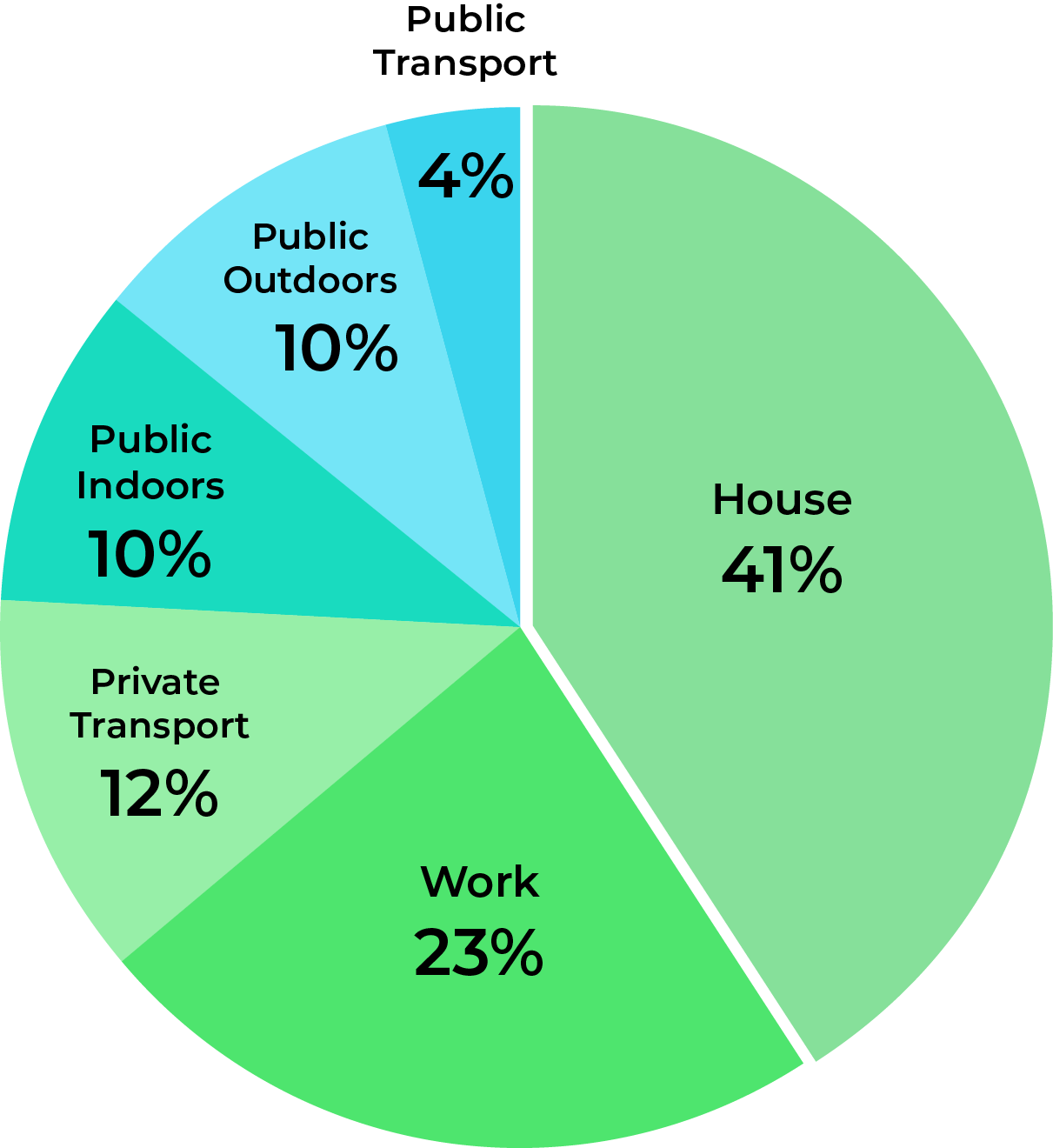
(Source: Analysys Mason, Swisscom Innovations)[8]
Operators have begun to see that the future of wireless is actually more about access and less about mobility. On the heels of the FMS (Fixed Mobile Substitution) wave will be a movement towards substituting DSL or cable broadband with full-time 3.5G access in the home. Advertising campaigns from operators without a sister DSL company are likely to be more overt in their stance that consumers should cut ALL of their cords. While this new disconnect is unlikely to have as large an impact on broadband operators as mobile substitution is having on the traditional wireline connections, it will be significant. More importantly, the majority of consumers in the world’s emerging economies may see their first home broadband connection be a wireless one. This is especially true outside the urban core. The consistency of the connection experienced by these subscribers will have a lot to do with the continued growth of 3G HSDPA (High-Speed Downlink Packet Access) systems and the positive migration to data-centric LTE networks.
There are three distinct indoor coverage enablers promising salvation and competing for the attention of operators. Each approach seems to suggest that an operator can both increase network performance and boost indoor coverage at the same time.
- Femtocells promise to unburden the macro network from an expanding amount of voice and data traffic by backhauling data over standard DSL and cable modem connections.
- Unlicensed Mobile Access (UMA) advocates point to a new wave of dual mode handsets that will work in concert with existing Wi-Fi access points.
- And now, Smart Repeaters have arrived … automatically adjusting to the best signal source and offering seamless network access while decreasing the demand for uplink and downlink power. These intelligent devices can simplify the process of extending indoor cellular coverage and maximize the effective data speeds of the macro network while protecting it from harmful interference.
These are compelling stories. And mobile operators are listening.
Repeaters, Boosters and Bi-Directional Amplifiers
Repeater technology has been used since the early days of terrestrial wireless communications. Its premise is fairly straightforward. A wireless signal is received over the air by a donor antenna which is connected to a signal amplifier. The amplifier sends the signal (via a coaxial cable) to an indoor server antenna. From here, it is redistributed throughout the room or building that was not able to obtain a sufficiently strong signal from the operator’s base station.
By using a bi-directional amplifier (BDA) approach, the cellular signal is amplified on both the downlink path (to the mobile device) and on the uplink path (back to the base station antenna). By increasing the gain of the re-transmission, the user experiences a stronger connection.
This traditional approach is used by military, public safety and government agencies to ensure consistent coverage areas for their Specialized Mobile Radio (SMR) systems. One-way repeaters (sometimes known as translators, relay stations, or booster stations) have been used for generations by the radio and television industry. They essentially receive and re-broadcast the original signal in order to provide in-fill service to areas that are obstructed from the original signal or to re-distribute the programming to outlying areas that could not be served by the primary broadcast antenna. In each case, these secondary rebroadcasts are carefully monitored by government agencies and licensed broadcasters to ensure that they do not interfere with any adjacent frequencies.
Today, cellular repeater systems can be found in office complexes where thick glass, metal and concrete construction materials serve to block the penetration of cellular signals from local base stations. These enterprise-class devices often cost upwards of $5000 U.S. and can be installed only with the consent of the licensed wireless operator, who continuously monitors their impact on the macro network. They are applicable in areas where the wireless operator cannot recoup the capital cost of deploying new base stations or installing smaller Picocells to supplement the coverage area generated by the nearest cell site. Distributed Antenna Systems (DAS) are used in large office buildings to redistribute the signals from all relevant mobile operators in the region. These systems are usually deployed by specialized systems integrators at the request of the building owners and often cost upwards of $100,000 U.S.
Traditional analog repeaters and boosters have not been embraced by mobile network operators to serve single family homes, apartments, flats or rowhouses. In fact, consumers are forbidden from using them in most countries since they transmit on frequencies that are the exclusive domain of a licensed operator. While they can prove effective in amplifying signals to and from an individual subscriber, their basic operation is crude and they are prone to over-amplifying signals on the outbound link and lowering the quality of service that neighboring subscribers expect. Their potential for raising the noise floor and creating harmful interference has always outweighed their potential for solving the in-home coverage challenge.
Repeater devices that transmit or re-transmit in the cellular bands are not licensable for use in the UK because there is the potential for them, either individually or cumulatively, to cause interference to the networks’ operation or planning.
— Section 8. Wireless Telegraphy Act of 2006 (UK). Ofcom[9]
Traditional bi-directional amplifier (BDA) products have been promoted for in-home use by electronics vendors outside the walled garden of licensed operators with limited success. These analog repeater products require a fairly rigorous outdoor (and indoor) installation procedure that often involves drilling through walls and powering amplifier units from attics or other inconspicuous locations. Due to the nature of their directional antennas, which must be mounted outdoors and precisely aimed at a nearby base station in order to be most effective, the opportunities for installer error and unintentional interference with the macro network are numerous. Once installed, these point-and-mount antenna approaches cannot react to environmental changes or network upgrades (such as new base stations) in their service areas. Individuals who install off-the-shelf consumer repeaters without the knowledge of their operator can rob their neighbors of network capacity and cause an overall reduction in the coverage area of the local cell. In some countries, mobile network operators have been known to employ Repeater Referral Programs for customers in remote or unserviceable areas, but only with their authorization and under their strict guidance.
Regulation, Authorization and Outlawed Devices
In the United States, there has never been an outright ban on the sale of consumer repeaters, although some industry groups continue to lobby the Federal Communications Commission (FCC) in hopes that the agency will take a concrete stance on their operation. Since the decision to allow them is at the discretion of each licensee, it is ultimately the Operator who is responsible for maintaining awareness and control over the transmitting devices that operate within their assigned frequencies. And they are increasingly protective. While the FCC allows the use of cellular repeaters and boosters without requiring that the devices to be licensed individually, it is not permissible for a subscriber to install one without the Operator’s consent.
Signal boosters are low-power transmitters used to improve communications in locations within the normal coverage area of a radio system where the radio signal is blocked or shielded due to natural terrain or man-made obstacles (e.g., to provide fill-in coverage but not increase the normal coverage area). Under Part 22, a form of signal booster, generally called a cellular repeater, may be employed by cellular licensees without separate licensing provided that the repeater does not extend the licensee’s signal beyond the authorized cellular service area. [10]
— Amendment of Parts 22, 90, and 94 of the FCC’s Rules to Permit Routine Use of Signal Boosters
The FCC’s historical wireless charter is to provision and police the use of the airwaves so that licensees can operate without interference. The agency is often called upon to clarify the rights and responsibilities of license holders when new technology impacts their businesses. It wasn’t long ago that hospitals, movie theaters and convention centers began to deploy specialized transmitters designed to jam the operation of cellular telephones. Their motive in this case was not to enhance indoor coverage. To the contrary, it was to prevent strong signals from reaching impolite indoor subscribers who might disturb other patients or patrons!
There are no provisions in the FCC’s rules that permit the operation of any device intended to interfere with cellular communications. Further, Section 333 of the Communications Act, 47 USC 333, prohibits any person from willfully or maliciously interfering with the radio communications of any station licensed or authorized under the Communications Act or operated by the U.S. Government.[11]
Traditional consumer repeaters are not designed with any intelligent functionality that would allow them to peacefully coexist within the structure of a shared mobile network. They arbitrarily amplify the signals of their owner’s wireless communications, but often degrade the operator’s network and rob other subscribers of network resources. In much the same way, the rude theatergoer amplifies his own voice so that he can be heard over the noise from the movie in the background; while other theater patrons within range suffer a less-than-acceptable user experience. While a consumer repeater owner is not motivated to “willfully or maliciously” interfere with the radio communications of a licensed operator, the result is often the same.
The U.S. also suffers from a less-than-foundational degree of clarity on how or if consumer-grade devices should be marketed. Many consumer electronics retailers and web-based shops sell boosters, repeaters and other similarly-described cellular signal extenders. They may feature an FCC certification on the packaging which would seem to suggest a federal endorsement that their use has been approved. Many vendors claim that their products are “certified” in this manner. In reality, they are only certified in the sense that they have passed FCC Part 90 or Part 22 testing for output power, conducted spurious emissions, radiated spurious emissions, frequency stability, transient behavior, or occupied bandwidth.
Cellular and PCS boosters and repeaters are transmitters and may only be used by licensed cellular/PCS providers or by end user customers with the express authorization of the licensed provider.
— FCC Spectrum Enforcement Division[12]
A Chasm of Confidence
Since the unintended consequences of dumb repeaters installed by well-meaning consumers can severely impact network performance, Operators have not often viewed them favorably.
Consumers cannot install repeaters without the consent of the cellular licensee. And cellular licensees are not likely to give their consent. This is the chasm of confidence that has kept the traditional repeater model from being a viable indoor coverage solution for most residential markets. Not only does the operator fear that an improperly installed device will degrade the performance of their network, they cannot risk the likelihood that booster-generated traffic would interfere with cellular companies and public safety systems operating on neighboring frequencies.
While repeaters are not illegal to purchase or own, the fact that they operate in the frequencies licensed by the government to the carriers means that individual users are violating the terms of those licenses when they switch them on.
— The New York Times[13]
Residential subscribers have been left with less-than-attractive choices: suffering with poor indoor coverage, switching service providers altogether in hopes of acquiring a stronger signal, installing repeaters illegally, or buying operator-approved business-class systems costing thousands of dollars. Legacy repeater designs have not been able to overcome the consumer market challenges that would make a compelling (and permissible) business case for mobile operators.
Cost:
Business-class devices, with sophisticated noise-gating features and remote monitoring capabilities can cost thousands of dollars. Outdoor antennas, cabling and permits from building owners add to the complexity which mobile operators can justify only for the in-building needs of their top business accounts. The enterprise repeater requires professional installation to ensure that each outdoor server antenna is properly oriented to the nearest base station. Even then, the network operator must be aware of each business repeater within the cell so that network upgrades which influence the positioning of these antennas can be accounted for. A user-installable device that meets stringent operator requirements for network performance and safety cannot be built from traditional components at a price point that would satisfy consumers.
Complexity:
The traditional repeater system requires an outdoor antenna to be aimed in such a way that it can receive a clean signal from the nearest base station. This very design requires it to be a permanent, fixed installation which means it does not react to changes in the network or to its surroundings. While consumer repeaters are simple from a component perspective, they require antennas to be mounted, holes to be drilled, and cabling to be run. Their design introduces a series of opportunities for installer error, which can cause serious problems affecting both the network operator and fellow subscribers.
Any degree of extended customer service time that would be spent coaching a subscriber through an installation with a host of individual variables would kill the business case for this type of home repeater. Residential service calls are not factored into consumer 3G business models. While a truck roll is a common business element for wired broadband providers, having an installer sent out for home repeater installation would typically be out of the question. Any consumer who has an operator’s permission to install a qualified product would end up paying considerably for equipment and installation. Legacy repeaters simply cannot meet the business demands for the mass market acceptance because they do not have out-of-the-box, plug-and-play capabilities that the mass market requires.
Interference:
Of greater consequence to the carrier community is the fear that a poorly designed or incorrectly installed device will interfere with network operators on adjacent frequencies. This would be a violation of the responsibilities of any license holder.
The impact of oscillating signal boosters can have a devastating impact on cellular like infrastructure.
–The National Public Safety Telecommunications Council (NPSTC)[14]
Legacy repeater products have been susceptible to oscillation in everyday use. The best analog designs feature auto-shutdown capabilities which render them temporarily inoperable when they are at risk of compromising network resources. In most common designs, a directional donor antenna is permanently mounted outside of the home and aimed towards the nearest base station. From here, a coaxial cable is run to its full length (in order to offer a sufficient separation between the amplifier and the donor antenna).
Oscillation describes the result of amplified wireless signals being received, amplified — and then retransmitted back and forth. This can even occur when a subscriber walks too close to a server antenna.
In much the same way as feedback from a microphone can create a painful experience for members of an audience in a concert hall; oscillation from a simple repeater system can harm the integrity of a mobile operator’s network. The resulting RF noise of an over-amplified signal that is relayed back to the base station can have serious consequences. Not only do these unintended transmissions diminish the size of the cell and cause neighboring subscribers to experience interrupted (or diminished) service quality, they may bleed over into the adjacent frequencies of other mobile networks. Legacy designs do not have the real-time ability to adjust to the changing circumstances of the RF environment — or to any physical changes in the carrier’s network.
The National Public Safety Telecommunications Council (NPSTC) has documented examples of interference between cellular frequencies and public safety networks. They believe that any instance of cellular interference has the potential for “severe consequences” to public safety operations.
One of the NPSTC’s most highlighted examples concerns a bi-directional amplifier that was used in the New York City area by a well-meaning subscriber. It was incorrectly installed which caused it to self-oscillate (ie. “to act as a transmitter radiating an interfering signal back out to the receiver antenna.”) By doing so it degraded a number of cell sites in the densely populated region and made it necessary for both the carrier and the manufacturer of the device to undertake a huge hunting expedition to locate the device so that it could be shut down.
The device in question turned out to be a well-made product. It did what it was supposed to do. The fact that it was improperly installed led to a situation where the network was degraded, subscribers in the area suffered from a lower quality of service, and two companies (both the cellular operator and the BDA manufacturer) had to redirect their resources to identify and locate the offending device.
The NPSTC has even tracked cases where boats using consumer grade boosters interfered with public safety networks on adjacent frequencies in Florida.
Network Degradation:
Cellular networks are painstakingly designed and continually upgraded based on the knowledge that standardized handsets are receiving signals from the base station and transmitting back at power levels that fall within a predictable range. When a rogue device continually blasts its uplink at higher-than anticipated levels — or utilizes a larger portion of the spectrum than is intended — the size of the cell coverage area will shrink and the overall capacity of the network will be reduced. This is a nightmare from the operator perspective and a key reason that consumer repeaters have been outlawed in many countries.
As previously discussed, cellular architects may be willing to budget network resources for lucrative business accounts served by expensive, carrier-class repeaters in order to retain these key enterprise accounts (with their large subscriber bases and heavy data plan users). As such they will accommodate business-class repeaters into their network planning. And they will manually monitor the performance of each enterprise unit and adjust to the burden it places on the network.
The damage that dozens or hundreds of indiscriminately installed and unmonitored consumer repeaters could do would be a frightening prospect for any network planner.
Indoor Alternatives? Femtocells and UMA
Two competing technology approaches in the battle to provide reliable indoor coverage are working their way towards market acceptance. Both have the support of the vendor community and the attention of many mobile operators throughout the world. Supporters of Femtocells and UMA (Unlicensed Mobile Access) technology are betting that a large percentage of customers who experience poor indoor service quality can be better serviced by leveraging the high-speed DSL and cable broadband connections that many consumers have in their homes. These are the two most popular examples of Fixed Mobile Convergence.
Femtocells:
A Femtocell is a consumer device which acts as a personal base station antenna within the home. These units are built to operate on a specific operator’s frequency and can generate a reasonably large coverage area for 3 or 4 registered users. Instead of transmitting uplinked voice calls and data services over the air, a Femtocell connects to the wireless operator’s network through each subscriber’s broadband DSL or cable modem. A Femtocell passes its “backhaul” data over a wired Ethernet cable and is similar in size to a wireless router. In most cases, a consumer will install the Femtocell in the same location as their primary computer and broadband modem: in a home office, a bedroom, the kitchen, or wherever the main broadband line enters the residence. Initial deployments of Femtocells will also include a GPS antenna, which is required for installation in order to ensure that the Femtocell is only operating in an authorized location.
The customer with poor indoor service may be asked to pay the full cost of the Femto hardware or an operator-subsidized portion of the cost. Customers may find that operators will waive the hardware cost if they complain about poor service and threaten to cancel their contracts. Internet message board postings from early Femto customers promote this fact to other subscribers. Operators may also charge a monthly Femto service fee in addition to the hardware, and will have the flexibility to market unlimited-use service plans for customers who make and receive in-home calls via their Femtocells.
Some mobile network operators are excited about the prospects for Femtocells, even though there is a heavy network management burden that must be mastered in order to maintain a community of users within a given macrocell (and technical hurdles to be overcome). Many in the vendor and carrier communities espouse the future benefits of offloading a great deal of network traffic onto the ISP’s network via each customer’s fixed broadband connection. Some believe that there will be a large, quantifiable backhaul savings for mobile operators if Femtocells were to catch on in a big way.
With a few years of research and development behind them and growing support for Femto industry standards, there is a good chance that quite a few operators will begin rolling out Femtocell solutions in the years to come. However, there is not a universal model for service structure as of yet. Many wireless subscribers already have unlimited calling tariffs, free nights-and-weekends, friends-and-family packages and other bundles that seemingly cover their at-home calling, texting and data access. It remains to be seen whether consumers will agree to pay extra for indoor service quality and unlimited calling that they may already expect from their existing wireless contracts.
Unlicensed Mobile Access (UMA):
UMA approaches to the in-home quality challenge offer similar, and sometimes indistinguishable, service plans for consumers. They are often promoted on the dual appeal of free at-home voice calls and strong indoor connection quality. UMA stands for Unlicensed Mobile Access, which is the commercial name given to the 3GPP Generic Access Network (GAN) standard. While Femtocells act as miniature base stations and operate on the licensed frequency of a particular mobile operator, a UMA solution depends a dual-mode device that performs a seamless handoff of voice and data traffic between the cellular network (when outdoors) and a Wi-Fi network when indoors.
The UMA concept is a few years more mature than the Femto approach, but the requirement for dual-mode handsets means that consumers have a smaller population of phones to choose from if they would like to adopt a UMA-based plan. Those who experience poor indoor coverage and want to take advantage of a UMA solution often find that the coolest, smallest phones don’t yet feature dual mode (Wi-Fi and cellular) chipsets. One added benefit that UMA advocates promote is that free calls can be made from home – or from any Wi-Fi hotspot with a dual-mode phone. While there is not an obvious benefit to free consumer Wi-Fi calls to many network operators, the value of keeping a customer from switching to a competing provider because of poor coverage is worth the tradeoff of losing a percentage of voice revenue.
Are these approaches competitive or complementary?
Should operators plan for more than one answer to the challenge of providing acceptable coverage indoors?
Yes. And they are.
Both the Femtocell model and the UMA model have their supporters. And with good reason. In the lab and increasingly in the field, both approaches have proven their ability to boost signal strength within the home. They are perhaps more attractive to some cellular operators because of the opportunity to offload the backhaul burden onto the customers wired broadband provider. Less backhaul expense and extra wireless network capacity can be calculated into real savings, or so the argument goes. Interestingly, there are quite a few mobile companies who operate as subsidiaries of larger telecom organizations. In these scenarios, the gains enjoyed by Femto and UMA wireless operators come at the expense of dumping a new data burden onto a sister DSL company, for example.
At any rate, the UMA and Femto approaches can serve only those customers with a home DSL or cable broadband connection (or those served by fiber-to-the-home infrastructure). That leaves the majority of the world’s population as an addressable market that might only be served by mobile operators who adopt the smart repeater approach. In addition, the technical hurdles faced by the Femto market and the slow rollouts of UMA make the smart repeater option a compelling one even to customers with a fixed line broadband connection.
Emerging world economies such as China, India and Brazil are likely to see mobile broadband become the first residential broadband option in all areas outside of the dense urban centers. In Eastern Europe, only the urban core shows an aggressive take up rate for fixed broadband services with DSL being the dominant option. Moscow, for example, is well served by DSL such that the city’s broadband penetration rate is approaching 50% — which puts on par with the United States. In areas outside of Moscow, fixed line broadband penetration[15] is only 4%.
Get Smart! Re-Inventing the Repeater
In order for a repeater-based model to solve the in-home coverage challenges that 3G operators and consumers are facing in the Mobile Broadband Era, the devices themselves have to be re-imagined, re-defined and re-created.
They must work in harmony with the macro network; not against it. They must be embraced by the Operator and regulatory communities; not outlawed. They must create customer value in the smallest quantities, and scale massively as demand dictates. They must continually monitor their environments, and adapt to any changes in the RF network. They must practically install themselves, and eliminate the potential for costly customer support calls. They must be productized to support churn reduction initiatives and be marketable through Operator-aligned retail channels. They must demonstrate immunity from overdriving base stations or raising the noise floor. They must coexist with Femtocell installations on adjacent frequencies. They must be adaptable to new form factors. They must meet reasonable price points. They must align with computer networking gear and consumer electronics devices. They must be secure. They must be self-adjusting. They must be self-configuring. They must have computational abilities. They must be … smart.
In much the same way as cellular phones became smartphones with an increase in processing power, and antennas became smart antennas with the arrival of adaptive arrays and signal processing algorithms, the standard bi-directional amplifier architecture can be energized with a purpose-built processor capable of delivering on the new wave of market requirements. It is necessary. It is inevitable. It is here today.
With intelligent processing power onboard, the new breed of repeater performs as an independent organism within the cellular structure; neither drawing nor receiving an inordinate amount of network resources from its host. They will not steal capacity from other smart repeaters in neighboring domiciles. They are invisible to the base stations in their midst, yet aware of every change in radiated power and path loss. They sense and react in a matter of milliseconds. They are faithful to the PLMN IDs of their assigned operators; to the exclusion of any other Operator’s signals that might be encountered. They will only work on the network of the licensed operator who has authorized their deployment.
A smart repeater system is a carrier-grade solution that is designed to eliminate in-building dead zones and work in harmony with the cellular macro network. With smart antenna technology and native intelligence, a smart repeater continually seeks out the best available signal and automatically adjusts to any changes in the RF environment in order to maximize the signal gain to the user. Smart repeaters are designed to protect the integrity of the wireless network while increasing the effective RF capacity of each base station. While the first wave of smart repeaters are optimized for W-CDMA networks and HSPA data, they are backwards compatible for 2G voice subscribers as well.
By rejecting the traditional Outdoor Donor Antenna/Indoor Server Antenna model, smart repeater advocates are able to present a business case which removes the complexities of installation and interference management.
How Smart?
With a baseband processor that is specifically designed for optimizing the transmission and reception of 3G voice and data in the home, a smart repeater is able to process complex algorithms and software-based commands in real time. Among the enhancements which can now be processed at the edge of the network are filtering and equalization to optimize system performance and increase data throughput rates, digital echo cancellation to optimize system gain and increase in-home coverage footprints, co-existence procedures to allow for mass market release and inter-operability with Femtocell deployments, advanced protection against unauthorized operating frequency changes, and procedures to guarantee network-safe behavior.
Full software programmability of all key system performance algorithms elevates the smart repeater into a new class of digital customer premise equipment.
Smart Repeater Architectures
A smart repeater system typically consists of two devices: an indoor smart antenna unit (also known as a window unit) and an indoor coverage unit. Each unit is self-contained and can be plugged into any standard electrical outlet within the home. Smart repeaters do not rely on external, roof-mounted antennas to supply pervasive in-home coverage. This distinction allows the solution to be installed by a subscriber in minutes; simply by plugging them in.
In a distributed 3-hop system – a specialized window unit (WU) captures the strongest outdoor cellular signal and transmits it wirelessly over a secure 5 GHz link to the coverage unit (CU). The smart antenna subsystem in the window unit automatically senses and adjusts to the direction of the best cellular signal source from outside.
Traditional repeater designs mandate that the server antenna and donor antenna are installed far enough apart to reduce the opportunities for oscillation to occur. A smart repeater system can actually represent the optimal degree of separation between the WU and the CU on a graphic user interface with universal symbols that are meaningful in any language.
As a result of advanced processing power, a smart repeater offers true plug-and-play operation from the Operator’s perspective as well. The system automatically selects the correct 3G frequencies based on the unique PLMN (public land mobile network) ID of the authorized Operator. This feature eliminates the need for regionally specific programming and provides the ultimate in flexibility for network frequency assignment.
By continuously monitoring the path loss between the window unit and the coverage unit, real-time adjustments are made to the uplink gain — which eliminates the potential for harmful interference associated with legacy repeater systems. True automatic gain control (AGC) is absolute. When there are no active handsets or wireless devices inside the home, a smart repeater is dormant on the uplink path. While the processor-powered smart antennas will sense and react to changes in the radiated power of the base station, they will not generate the continuous upstream traffic and noise that legacy repeater products are known for.
Since a core processor is at the heart of each smart repeater, it is conceivable that the two-box design could find its way into other form factors. While the window unit houses a smart antenna subsystem and is operates best located near a window, the components of the Coverage Unit could be integrated into a variety of synergistic consumer electronics devices or networking products.
Mobile network Operators are showing a great deal of interest in the smart repeater model because it is self-sustaining and scalable. By increasing in-home data rates and voice quality, an Operator is just as likely to increase subscriber retention and ARPU. By improving the photo imaging, mobile gaming, video sharing and social networking experience in their customer’s homes, Operators will also increase subscriber loyalty as new 3G and 3.5G applications come online.
A specialized technology stack is beginning to form around Physical AI. At Actuate 2026, developers got a close look at its emerging data, simulation, training, observability, compute and teleoperation layers, offering a glimpse of an ecosystem being assembled in real time.

The firms that rewired the digital world now aim to transform the physical one. And just as they did with digital transformation, the consulting giants are positioning themselves to support this next era of enterprise reinvention.