

I wrote and published the following case study which originally appeared as one of Microchip’s web-based Customer Stories during the time I served as Technology Marketing Advisor for the company.
From the earliest attempts to harness volcanic gas or burning oil, humans have been lured by the prospects of squeezing more useful hours from each day by lighting up the night. Municipal streetlights have been illuminating the paths of travelers for hundreds of years now, with many urban cores operating 24/7 as cities that never, or rarely, sleep.
 City governors would mandate the use of oil-based lamps on the street-facing walls of city homes to make nighttime a less menacing part of the daily cycle. As public streetlamps were deployed, designs evolved from weak, overhead flames burning from wicks soaked in fish oil to increasingly more advanced designs. Innovative, silver-plated copper reflectors which could mechanically focus and steer a flame’s light became popular during the 1760s. Decades later, gas-powered lamps reached the mainstream and introduced a brighter network of ‘artificial suns’ along with a new job title: lamplighter.
In less than a century, urban planners migrated from gas-powered lamps that were often maintained by police departments to fully-electrified lighting systems leveraging matrices made up of thousands of lampposts stationed alongside city streets. In modern times, we are witnessing the next transition: from high-pressure sodium (HID) lamps, which are still the most common type of streetlight, to more efficient LED solutions.
The Spotlight is on Streetlights
Public sector streetlighting is often the largest fixed expense from a city’s general fund each year. That’s one reason why the lure of LED-based solutions promising substantial operational savings is such an easy door opener among city administrators.
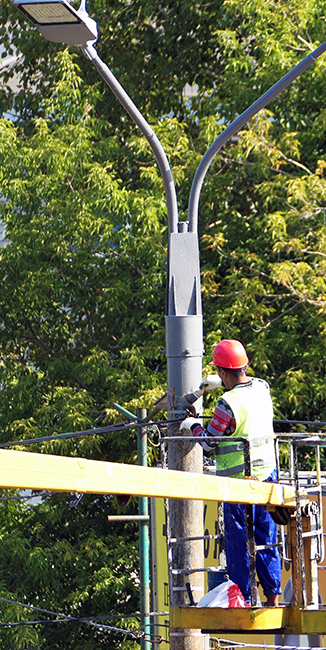
As public utility organizations work with their trusted vendors to address the migration to LED-based lighting, all manner of related technology advancements have been introduced into the mix. The height, location and elevation of a municipality’s streetlights (or more importantly, their poles) offer a promising locale for smart traffic sensors, security cameras, public Wi-Fi hotspots, environmental sensors, small cell wireless antennas, solar panels, electric vehicle charging stations, and IoT nodes for applications that have yet to be developed.
THE CHALLENGE
A leading lighting systems vendor approached Microchip to discuss their vision for interconnected streetlights as a prerequisite for future Smart City initiatives. They described the landscape of LED streetlights as lacking widescale connectivity and an operating environment without universal standards. Urban leaders often faced expensive operational costs and maintenance burdens, along with less-than-stellar energy efficiency outcomes. Their experts felt that a strong response to increasing municipal demands for Smart City IoT solutions and the opportunity to introduce smarter streetlight solutions would give them a competitive edge in their regional markets and enhance their position globally.
A Catalyst for the Smart City
Smart City schemes promise cost-effective solutions for managing public assets and interconnection among neighboring communities. In both state-run utility agencies and in highly-regulated public/private agencies, the concept of streetlights as catalysts for Smart City projects has a great deal of momentum. IoT-enabled streetlights of the future are projected to decrease the cost of municipal lighting and offer advanced capabilities that were unthinkable a generation ago. City managers will be able to manipulate the illumination levels throughout the day, increasing them gradually as sunset approaches. Spikes in vehicle traffic, dynamic changes in weather conditions, antisocial behaviors and public gatherings at major events could all be supplemented with increased lighting from smart city platforms (SCPs). Secondary services including air quality measurement and noise pollution monitoring could be supported by the smart lighting networks.
THE SOLUTION
The initial meeting led to more detailed discussions between the Microchip sales team and the vendor’s design and executive teams. With a long history of success in the development of microcontrollers, embedded wireless connectivity solutions and security applications, Microchip proposed an innovative LoRaWAN™-based approach for the company’s next-gen connected streetlights in collaboration with a trusted distribution partner.
This project mandated a solution that could produce a low total cost of ownership and simply the design process so the solution could be launched in a short time frame. Interoperability for future expansion and wide-scale deployment were also critical to the success of the project.
Low Power, Wide Area Networking with Security Baked In
Microchip’s new 433/868 MHz LoRaWAN module turned out to be ideal. It addresses increasing demands on end-devices for long-range connectivity, low power for battery operation, and low infrastructure cost for volume deployment.
IoT-Enabled LED Luminaire

The Microchip module comes with the LoRaWAN protocol stack, so it can easily connect with established and rapidly expanding LoRa Alliance infrastructure— including both privately managed Local Area Networks (LANs) and telecom-operated public networks—to create Low Power Wide Area Networks (LPWANs) with nationwide coverage.
Hybrid Wireless Connectivity
For short-range wireless connectivity, the connected streetlight solution would rely on a trusted module from Microchip’s Bluetooth portfolio. With a small form factor, the surface mount module has the complete Bluetooth stack on-board and is controlled via simple ASCII commands over the UART interface. The device also includes all Bluetooth SIG profiles, as well as MLDP (Microchip Low-energy Data Profile) for custom data.
High performance and reliability characteristics made the Microchip SST26VF016B Serial Quad I/O (SQI) flash device a perfect choice. Utilizing a 4-bit multiplexed I/O serial interface to boost performance while maintaining the compact form factor of standard serial flash devices, the SST26VF016B also supports full command-set compatibility to traditional Serial Peripheral Interface (SPI) protocol.
THE RESULT

A specialized technology stack is beginning to form around Physical AI. At Actuate 2026, developers got a close look at its emerging data, simulation, training, observability, compute and teleoperation layers, offering a glimpse of an ecosystem being assembled in real time.

The firms that rewired the digital world now aim to transform the physical one. And just as they did with digital transformation, the consulting giants are positioning themselves to support this next era of enterprise reinvention.