
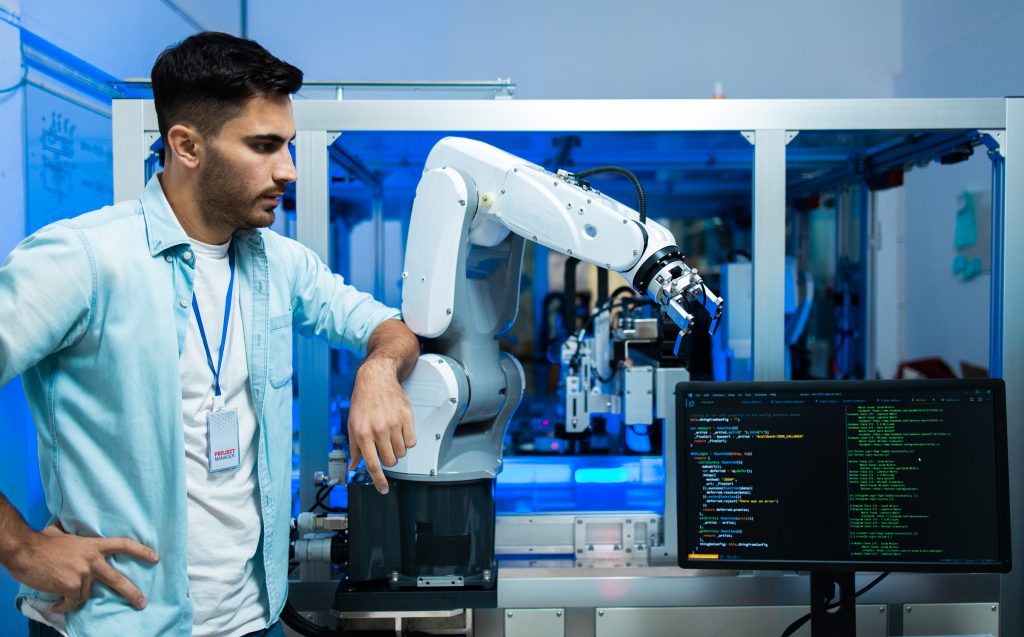
Looking back at 2025, we may remember the telltale signs that something big was brewing. Yes, there were many AI productization activities, research milestones, and money (lots of money) devoted to advancing LLMs and agentic AI. Those stories aren’t as interesting to me as potentially mothballing what we think we know about industrial robotics in favor of a new kind of understanding. The mainstreaming of embodied intelligence. And spatial intelligence. A post-robotics age.
I see a bigger tent that absorbs many splintered innovation segments and adds white hot categories like world foundation models (WFMs), vision-language-action (VLA) models, and soft robotics, and wraps them into something new. And we will need a name for that. But the fact is, we already have one.
In my view, 2025 was the year that “Physical AI” started to absorb decades of academic research jargon, lab-scale breakthroughs, practical automation use cases and dancing humanoid videos, rolling them into something that resembles a new market. A very large market.
It has been building for a couple of years. Purdue University announced its multidisciplinary Purdue Computes initiative in April of 2023 with strategic pillars uniting computing departments, strategic AI research, and semiconductor innovation. One of the immediate outcomes was the establishment of their Institute for Physical AI (IPAI), which they described as the nation’s first university institute dedicated to Physical AI. I am guessing that we will see more newly minted Physical AI institutes going forward. Take the over.
It is not just in the halls of academia either. Today, you will notice more and more organizations using Physical AI phraseology in a very deliberate way, on websites, in slide decks, at conferences, and in their research papers.
Nvidia CEO Jensen Huang called it out by name during his CES keynote in January, on the heels of the company launching Cosmos WFM to give developers new abilities to harness real-world data in volume.
“It started with perception AI … understanding images, words and sounds. Then generative AI … creating text, images and sound. Now, we are entering the era of physical AI … AI that can perceive, reason, plan and act.”
But not everyone is on board. At least not yet.
And that’s perfectly natural. We have seen this multi-wave cycle before. The technologists who have spent their careers developing smarter machines and pushing the limits of autonomy in factories and warehouses may find it hard to embrace a simplified, catch all, meta-category like Physical AI, even as its popularity grows within the wider world.

VCs Are Buying In
Investors seem to approve. And they play a critical role in transforming academic terms into market disruptions that they can sell to their limited partners. This jargon-to-market metamorphosis is why Physical AI has an opportunity to become the commercial category term that embodied intelligence never did.
When investors converge on a term, founders start using it in decks, journalists echo it, and suddenly that term defines the entire opportunity space.
A little history …“Embodied intelligence” emerged as an important concept in research during the late 1990s, but it never really described a market. Investors, industrial buyers, and ecosystem participants need a clean framework for what comes after the digital, software-centric AI that dominates the news today. Embodied intelligence is about to get swallowed up by the more obvious mass market term and live on as a key sub-segment.
The Full Stack Story
Physical AI captures the full stack of real-world intelligence: sensing, simulations, robotics, autonomy, digital twins, and the orchestration of machines that can actually act in the physical world.
It is the difference between a phrase in a patent and a massive commercial category.
Physical AI spans warehouse automation, robotics, manufacturing intelligence, mobility, edge intelligence, digital twin simulations, synthetic data and much, much more, along with the physical industries that make up most of the global economy.
As more companies build AI systems that sense, react, move, lift, pick, navigate, and operate, I believe the industry will coalesce behind the natural moniker that reflects the scale of the opportunity.
Physical AI is that name.

Same as It Ever Was
Highly technical labels rarely become the names of mainstream markets. Instead, they pass through at least three waves of acceptance: a specialist phase where the term is precise and narrow, a translation phase where a simpler label competes for mindshare, and a consolidation phase where one term wins and anchors investment, regulation, and the public imagination. In each wave, early pioneers risk losing narrative control just as the sector they help to invent finally becomes legible to everyone else.
1. The Specialist Wave: Precision in the Lab
In the first wave, terminology is written by engineers, researchers, and standards bodies, not marketers or investors. The priority is internal precision and signaling credibility within a narrow community, not accessibility for customers or the public.
Naming conventions emerging in this phase are often technically correct but linguistically heavy. They are descriptive of genuine breakthroughs. Because the audience is made up of peer groups and other specialists, the language assumes shared context. Acronyms are everywhere, and labels often reference architecture choices rather than outcomes.
2. The Translation Wave: Morphing into a Narrative
The second wave begins when a term stops being an internal shorthand and starts competing in a broader marketplace of narratives. At this point, a simpler, more resonant term often outperforms the technically correct one. Cloud begins to beat “distributed” or “hosted” infrastructure, for example.
Three forces tend to drive this translation wave:
Simplicity often wins because metaphors like “cloud” are easier to remember, say, and visualize than a stack of infrastructure acronyms.
Story fit matters because words like “drone” pair neatly with video, news, and defense narratives.
Commercial leverage comes into play as vendors, investors, and media converge on whatever term makes it easiest to tell a growth story and differentiate from the previous era.
This is often the moment when early technologists feel like they’re losing control of the narrative. The new label is fuzzier, sometimes even technically incorrect. “The cloud” is the classic example: a term that began as a simple diagram symbol and suddenly exploded in popularity and swept together hosting, virtualization, orchestration, and managed services into one catch-all category. Not everyone was thrilled about that.
Another example: The quick acceptance of “drone” ignored important distinctions in autonomy, control, and safety that the first innovators who coined unmanned aerial vehicles (UAVs) or unmanned aircraft systems (UAS) felt strongly about.
These imperfect labels that stick are the ones that dramatically expand the surface area of adoption. Once the market can say the word, it can budget for it, regulate it, organize conferences around it, and hire for it.
A quick search of LinkedIn Jobs shows Deloitte and Nvidia promoting new roles with Physical AI in the title. Let’s watch that number explode in 2026.
3. The Consolidation Wave: Consensus into Category
In the third wave, a term hardens into a recognized category with institutional infrastructure around it. Analysts create forecast lines, standards bodies and regulators formalize definitions, industry associations and conferences reinforce the label, and financial markets package it into investable themes.
By this stage, arguing about whether “cloud” or “drone” is the best term becomes mostly academic. The word is now sitting comfortably inside taxonomies, contracts, RFP templates, course descriptions, and policy documents.
As this happens, you can feel the shift. An M&A thesis describes how an acquired company will help the buyer leap into the next generation overnight. Job postings, certifications, and higher-ed curricula adopt the label, training the next wave of practitioners to think in similar terms.
Many major technology categories have gone through these shifts. Specialists name the thing. The market renames it. Institutions then cement that name into infrastructure, and it is locked in. It happened with fintech, crypto, and the Internet of Things.
For pioneers, this probably feels bittersweet. The name that wins may not be one they used in their white papers. But it is this consolidation that turns a niche innovation into a durable market. Some of the most prominent researchers and business innovators have yet to say or write “Physical AI” when they reference their industry. They may be fighting it still. These early ringleaders face a choice. Retrofit the old category definition or endorse the new label and ride the wave.

The Overall AI Narrative Is Splitting
Physical AI is defining itself, with a wide variety of inputs, as a fusion of AI models, robotics, sensing, and real-world execution. Unlike traditional (digital world) software AI, Physical AI will ultimately perceive, decide, and move through real environments, after an unprecedented number of simulations of course.
If a consensus is forming, Physical AI systems appear to combine:
• Perception to sense the real world: cameras, lidar, and industrial sensing suites
• Intelligence to interpret and decide: foundation models, planners, autonomy layers
• Action to execute in physical space: arms, AMRs, drones, manipulators
• Simulation to validate systems: digital twins, synthetic data, scenario generation
• Infrastructure to operate at scale: edge computing, orchestration, cloud robotics
Why this matters
This reframing, as an industry builds around these concepts, is particularly important for investors and policymakers. Physical AI is a different class altogether from the generative AI chatbots and LLMs that we have become familiar with. Physical AI will include many of the same players but will pull in significant leaders from traditional robotics and industrial automation too.
Physical AI signals that this is not just more of the same AI or automation in a new environment. It is a new coordination between models, sensing, actuation, and real-world impact. Getting that label right early shapes which metrics get tracked and which companies get taken seriously.
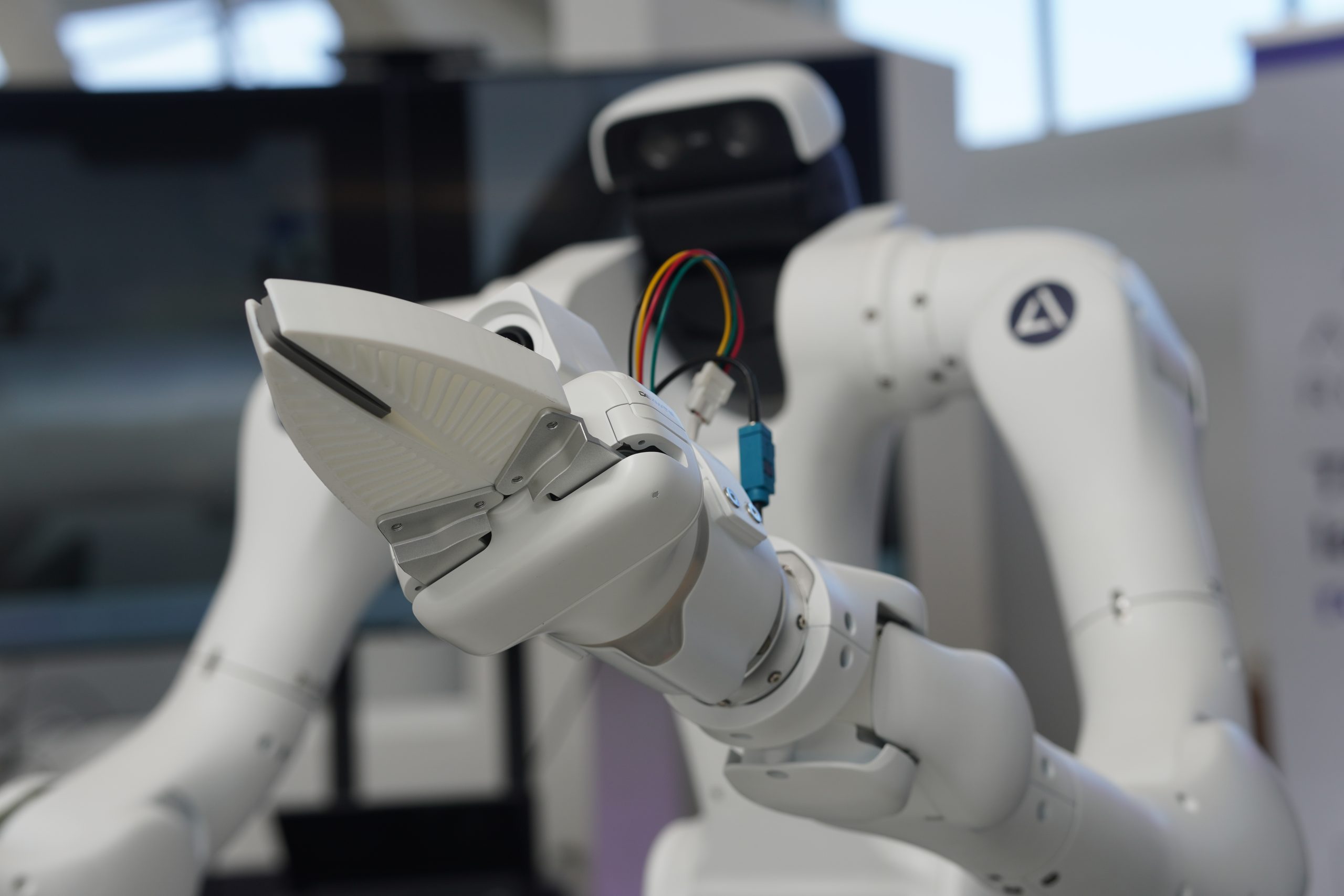
A specialized technology stack is beginning to form around Physical AI. At Actuate 2026, developers got a close look at its emerging data, simulation, training, observability, compute and teleoperation layers, offering a glimpse of an ecosystem being assembled in real time.

The firms that rewired the digital world now aim to transform the physical one. And just as they did with digital transformation, the consulting giants are positioning themselves to support this next era of enterprise reinvention.